
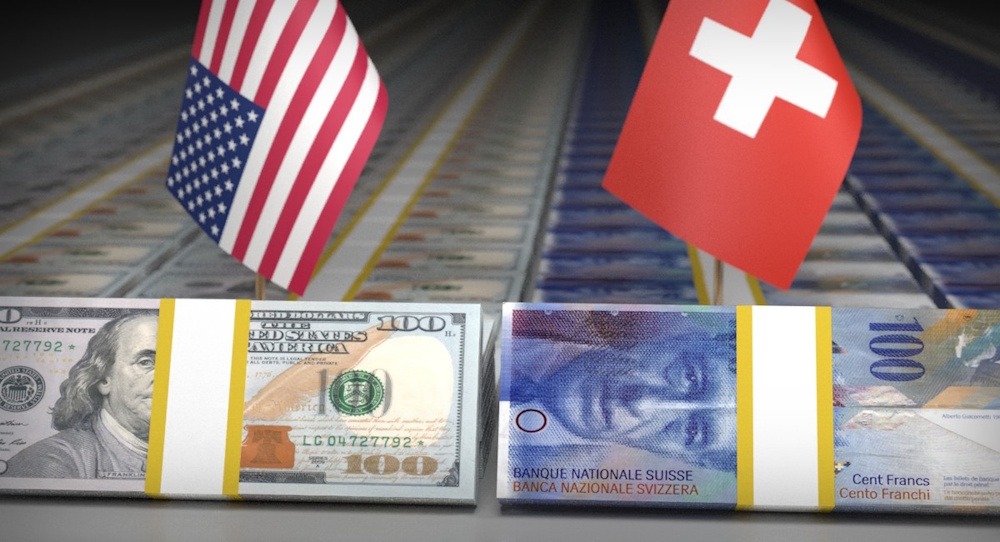
USD/CHF faces challenges in finding direction on Monday, as disappointing Swiss economic data puts pressure on the Swiss Franc, while a weaker US Dollar restrains upward movement. Currently, the pair is trading at approximately 0.7738, reflecting a decrease of 0.16% for the day. The Greenback faced renewed pressure following the announcement of a 15% global tariff by US President Donald Trump, which was a response to a recent ruling by the US Supreme Court that deemed his use of the International Emergency Economic Powers Act for imposing extensive tariffs as unlawful. The recent development has brought back worries regarding the stability of US policies and the credibility of its fiscal measures, impacting US assets as Trump’s assertive trade strategy continues to be a consistent burden on investor confidence. Market participants are currently keeping a close eye on trade-related developments for new direction. The European Parliament has seemingly halted the ratification process of the US-EU trade deal, while India has delayed negotiations intended to finalize an interim trade agreement with Washington.
Nonetheless, the US Dollar remains largely stable as market participants look for more definitive indications regarding US trade policy. The US Dollar Index, which monitors the Greenback against a selection of six key currencies, is currently positioned at approximately 97.67 after reaching an intraday low close to 97.35. The economic calendar in the US showed minimal activity. Factory Orders fell by 0.7% month-over-month in December, falling short of the anticipated 1.1% increase and indicating a significant deceleration from the prior 2.7% growth. Investors processed comments from Federal Reserve Governor Christopher Waller, who expressed a differing opinion in support of a 25 basis point rate cut during the January meeting, highlighting worries regarding the labor market. Waller stated that “all data for the past year indicates labor demand is falling more than labor supply” and cautioned that a “weak labor market is likely to continue going forward.”
In Switzerland, data from the Federal Statistical Office indicated that Producer and Import Prices decreased by 0.2% month-over-month in January, contrasting with expectations of a 0.1% rise and aligning with the decline observed in the previous month. In January, Producer and Import Prices experienced a decline of 2.2% year-over-year, after a 1.8% drop in December. This week, the US economic calendar appears to be quite light, and it is not expected to significantly alter the outlook on the Fed’s monetary policy trajectory. Focus will be directed towards the four-week average of ADP Employment Change and the Conference Board’s Consumer Confidence report on Tuesday. Markets will keep an eye on President Donald Trump’s State of the Union address on Wednesday, followed by the weekly Initial Jobless Claims on Thursday and the January Producer Price Index scheduled for Friday. Frequently Asked Questions about the Fed The Federal Reserve plays a crucial role in shaping monetary policy in the United States. The Federal Reserve has a dual mandate: to ensure price stability and promote full employment. The main method employed to reach these objectives is through the modification of interest rates. When prices are escalating rapidly and inflation exceeds the Fed’s 2% target, it leads to higher interest rates, which in turn raises borrowing costs across the economy. This leads to a more robust US Dollar, enhancing the appeal of the US for global investors looking to allocate their funds. When inflation dips under 2% or the unemployment rate rises excessively, the Fed might reduce interest rates to stimulate borrowing, which impacts the value of the Greenback.
The Federal Reserve conducts eight policy meetings annually, during which the Federal Open Market Committee evaluates economic conditions and determines monetary policy actions. The FOMC consists of twelve officials from the Fed: seven Board of Governors members, the president of the Federal Reserve Bank of New York, and four of the other eleven regional Reserve Bank presidents, who rotate in one-year terms. In critical circumstances, the Federal Reserve might implement a strategy known as Quantitative Easing. QE represents a method through which the Fed significantly boosts the availability of credit in a stagnant financial environment. This approach is typically employed in times of crisis or when inflation rates are significantly low. It was the Fed’s weapon of choice during the Great Financial Crisis in 2008. The process entails the Federal Reserve increasing the supply of Dollars and utilizing them to acquire high-quality bonds from financial entities. Quantitative easing typically leads to a depreciation of the US Dollar. Quantitative tightening is the opposite of QE, where the Federal Reserve ceases its bond purchases from financial institutions and refrains from reinvesting the principal from maturing bonds to acquire new ones. The value of the US Dollar typically experiences a positive trend.