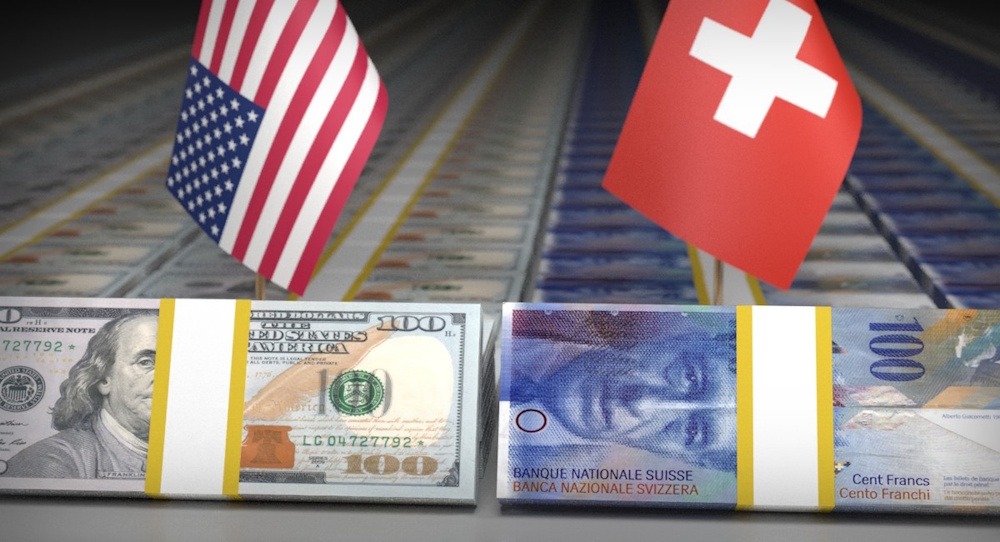
Softer US inflation and flat wholesale prices exert downward pressure on the US Dollar. Expectations for a rate hike by the Federal Reserve in September have decreased to approximately 35%. Swiss inflation has moderated to 0.4%, although expectations for long-term rate hikes by the SNB continue to be factored in. USD/CHF halts its four-day winning streak, trading around 0.8140 during the Asian hours on Friday. The currency pair edges lower as the US Dollar faces downward pressure following a softer-than-expected US inflation report. Market focus is shifting to the forthcoming US July Retail Sales data, which is set to be released later today. In the context of the overall inflation landscape, the Bureau of Labour Statistics indicated that wholesale costs for goods and services in the US remained unchanged in July, a cooling effect surpassing the expected 0.2% increase, following a revised 0.1% decrease in June. Excluding the more volatile food and energy components, the core Producer Price Index experienced a 0.2% increase, which was marginally below the market consensus expectation of 0.3%.
On an annual basis, headline PPI rose by 4.7% year-over-year in July, while core PPI experienced a 4.2% increase during the same timeframe. These cooling inflation metrics have altered expectations concerning Federal Reserve policy. According to the CME FedWatch Tool, markets are currently assigning a 34.8% probability to a U.S. rate hike at the forthcoming September meeting, a decrease from 40% immediately after the PPI data release. Meanwhile, inflationary pressures in Switzerland have also shown signs of moderation. Swiss inflation decreased to 0.4% in July from 0.5%, marking its lowest level in four months. This development underscores the limited transmission of elevated energy prices associated with geopolitical tensions.
This lower reading contrasts with the Swiss National Bank’s expectation of a modest near-term pickup in inflation, which followed its recent decision to maintain its policy rate at 0%. The SNB is anticipated to maintain borrowing costs at their current levels for the remainder of the year, viewing any potential cuts as a contingency rather than a primary scenario, particularly in light of the fact that Swiss banks have not experienced significant distress. While the majority of economists anticipate that the first SNB rate hike will not occur until early 2028, currency markets are nonetheless factoring in a potential increase as soon as March 2027.
Analysts note that “near-term inflation risks remain limited,” even as the recent depreciation of the Swiss Franc could eventually feed through via higher imported prices. They judge that any such impact “is unlikely to be felt for at least another two quarters,” and stress that domestic price pressures “remain subdued and below the midpoint of the SNB’s 0-2% price stability range,” reinforcing expectations that the SNB can afford to stay patient on policy and tolerate further Franc weakness.