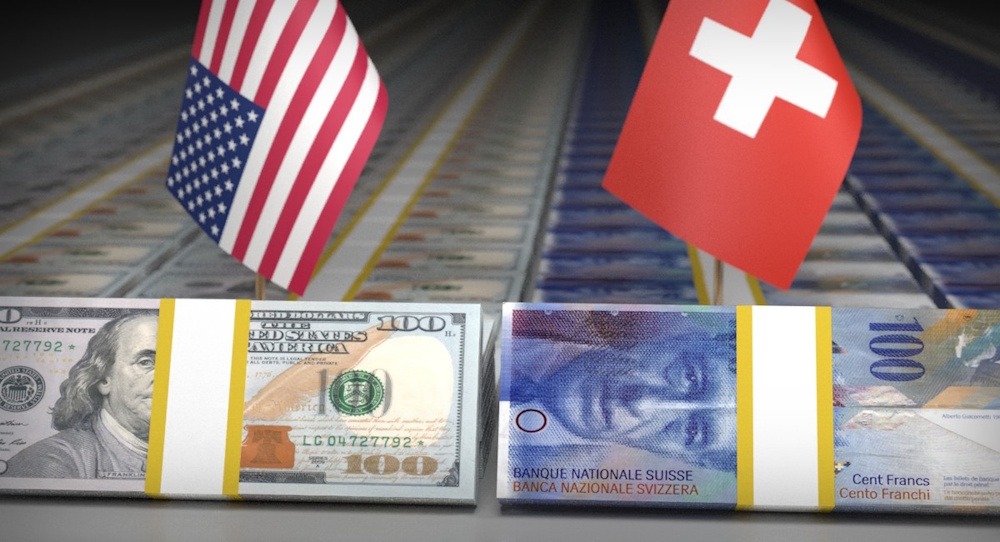
Easing tensions in the Strait of Hormuz reduced safe-haven demand for the US Dollar, leading to a depreciation of the pair. The United States, Iran, and Oman are anticipated to finalise an interim agreement aimed at reopening the Strait of Hormuz, with an announcement expected on Wednesday. BBH’s Elias Haddad notes that the low inflation in Switzerland, coupled with a consistent stance from the Swiss National Bank, continues to exert pressure on the Franc, which has emerged as the weakest currency in the G10 this quarter. USD/CHF continues to decline for the second consecutive day, currently trading near 0.8080 during the Asian session on Wednesday. The pair depreciates as the US Dollar loses ground due to a decline in safe-haven demand, which is influenced by increasing diplomatic momentum regarding a potential agreement to reopen the Strait of Hormuz. Source reported that the United States, Iran, and Oman are nearing an interim agreement to reopen the Strait of Hormuz, with the US targeting a Wednesday announcement.
The report also stated that the deal under discussion establishes a 60-day temporary arrangement between Oman and Iran in the Hormuz Strait, a critical chokepoint for nearly 20% of global energy supply, which may be subject to extension. However, the US Dollar may experience slight support from a rebound in the benchmark 10-year US Treasury yield after it fell to approximately 4.61% on Tuesday. The initial decline in yields was influenced by decreasing energy prices, which alleviated inflation concerns and moderated expectations of a hawkish stance from the Federal Reserve. Fed’s Schmid conveyed a slightly more hawkish message compared to the historical average, achieving a 7.3/10 FXS Speechtracker score against a 7/10 baseline. He emphasised that the current policy stance is “not tight” and indicated that a tighter monetary policy is necessary to bring inflation back to the 2% target.
The focus on AI-related investment as a new catalyst for inflation, the caution that the recent disinflation is insufficient to validate a sustained easing trend, and the perspective that inflation continues to be “too high” and “concerning” all strengthen the inclination toward additional restraint, despite the characterisation of growth and the labour market as resilient and relatively balanced. By emphasising the PCE gauge as the favoured inflation measure and warning that energy relief could be short-lived, the speech distinctly tilts toward mitigating potential upward price pressures rather than endorsing forthcoming rate reductions. The FXS Fed Sentiment Index decreased by 0.96 points to 145.80, indicating a modest retreat in perceived hawkishness subsequent to the speech. However, with the FXS Fed Sentiment Index still significantly above the neutral 100 line, the Fed continues to operate within a hawkish stance despite the slight softening, which aligns with the high FXS Speechtracker reading and Schmid’s emphasis on ongoing inflation risks.
Analysts observe that Swiss price pressures continue to be quite muted, with July inflation reported as “in line with consensus.” They emphasise that “headline CPI printed at 0.4% y/y vs. 0.5% in June while core CPI remained at 0.3% y/y for a fourth straight month,” reinforcing the Swiss National Bank’s assessment of only modest inflation over the forecast horizon and assisting in maintaining the policy rate at 0.00%. In this context, Elias Haddad at BBH posits that the enduringly low inflation environment and consistent stance of the SNB are exerting downward pressure on the Swiss Franc, which has emerged as the weakest currency in the G10 cohort thus far this quarter.